Web Performance Is Now Your Competitive Advantage
More Traffic Is No Longer The Answer
Adjusted for inflation, the average Cost Per Click (CPC) is roughly 40% higher than in 2014. Further, the current trajectory shows that this cost will continue to rise.
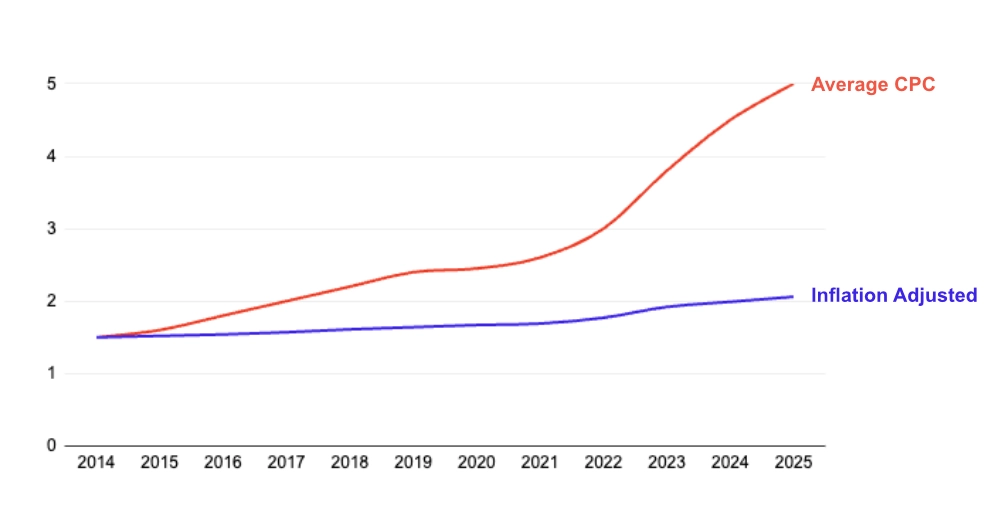
CPC is a good and easy-to-measure proxy for all acquisition channels. For example, consider Instagram ads: if you spent $1,500 on Instagram ads in 2014, you might spend roughly $5,000 today for the same number of clicks. These effects affect all acquisition channels, such as SEO or social media marketing, where you also have to spend far more today.
The last 2 billion people left offline are in remote villages with more expensive infrastructure trade-offs, so new people are coming. We’ve converted all the services we can into software services, and all the products you can buy in a shop are already online. In economic terms, the internet is now the red sea rather than the blue ocean: you only get attention and therefore customers if you wrestle it from someone else.
There is often pushback from motivational business gurus on the idea of competing for the same resource. They claim that we should have an “abundance mindset” rather than see things as a “zero-sum game”. This is a clear false dichotomy; almost nothing in business is a complete zero-sum or unlimited abundance. It’s a sliding scale between the two, and in 2026, we’re closer to scarcity than in 2014, and we’re moving further away from abundance every day.
In e-commerce, the market is growing at around 7% per year, but the number of online stores is shrinking—from 27 million in 2014 to 24 million in 2025. A smaller set of top players is capturing a larger share of an increasingly concentrated market. This means a newcomer now competes with 24 million stores instead of 27 million. Yet the top 1% are swallowing an even more significant share.
As the acquisition costs of new customers have increased, your real leverage lies in conversion and retention. Consider this: boosting your repeat purchases by just 5% gives you more revenue than increasing your traffic by 20%.
Retention and Conversion are more important
The cost of acquisition eats into a customer's lifetime value, and sometimes it costs more to make a sale than you get back. Therefore, businesses that convert traffic and keep people returning are at a significant advantage.
You see this in your email inbox every day. We are segmented into cohorts and analysed to figure out exactly what to send us, when, to increase the chance that people like us will buy again, and they’re continuously testing us. This has been shown to work, but as we get email fatigue, we unsubscribe more ruthlessly than ever before. When was the last time a brand email delighted rather than drained you? Our email inbox is also the Red Sea now. Email sequences have diminishing returns.
Another thing is all these popups telling us that something's on sale for another 15 mins or that 3 people bought this today. There is a strong correlation between the number of pop-ups and the bounce rate. For instance, sites with more than 3 pop-ups see bounce rates jump 22%. There is also an inverse relationship between the number of pop-ups and the number of return customers. Tests show that if the pop-up is delayed or only shows when the page is scrolled, the negative effects are reduced. But customers adapt quickly, maybe lying to them about the sale is a very short-term win.
The things that have consistently worked are nice to your website visitors rather than trying to trick them.
There are some really obvious and proven ways to improve conversion, retention, and repeat customers. And while they seem so obvious, you may feel they don’t need saying… we’ve consistently decided to make all of them worse.
Let’s look at a few of these:
- Performance: Over the past 10 years, the median page weight on desktop has grown significantly, increasing from around 1 MB to approximately 3.4 MB.
- Accessibility: over 95% of home pages have at least one accessibility issue. The average has 51 errors.
- UX: The average website has far more buttons and navigation elements than a decade ago
The current trend is to make websites slower and harder to use than they were ten years ago. What’s interesting is that this was the trend before AI code generators came along. Which means we’re training AI on slow, poorly accessible, poorly designed websites, and many new hires have been trained to make websites bad, too.
This is good news for you because your competitors overlook some of the most valuable ways to keep your business competitive. And following the current trend, they will continue to make theirs worse while you make yours better.
AI-generated code is bad for performance
LLMs work by predicting the next token in a text sequence based on the preceding tokens. They do this based on everything they’ve been trained on, which is all the code with performance issues. It is predicting the code you most likely want. It doesn’t know why one might be better than another.
Training AI on code from other codebases is rarely useful to you; the other codebases used different dependencies or utility functions. The AI is now adding all of these to your codebase. It can choose to create its own. It doesn’t see any issue with this because it’s simply predicting the most likely code that you are asking for.
Some people believe this is something they can come back and fix later. When the LLM gets better, we can improve our code then. This ignores how LLMs actually work; they have no understanding of what is better. Other AI models can improve web performance in future, but they will require a significantly larger setup, similar to training a new staff member yourself.
AI-generated code tends to be more verbose and introduces larger JavaScript payloads. For example, AI once suggested using a 120 KB library to solve what could have been a simple 2-line problem, adding an unnecessary 300 milliseconds to loading time on a 3G connection.
This means that some of the most valuable tasks in web development today are actually the ones that AI is incapable of. As the landscape becomes more competitive, we need to keep every customer who visits our site happy, engaged, and eager to return. This is one problem AI (or at least LLMs) can’t fix.
Performance Wins
If you want to start improving your web performance today, read Optimising UI for the new INP Web Vital next. If you want a full audit and performance tune of your site, contact us.